Materials
Every material has its strengths. We'll help you choose the right one based on what your part needs to withstand - mechanical load, temperature, UV radiation, or chemicals.
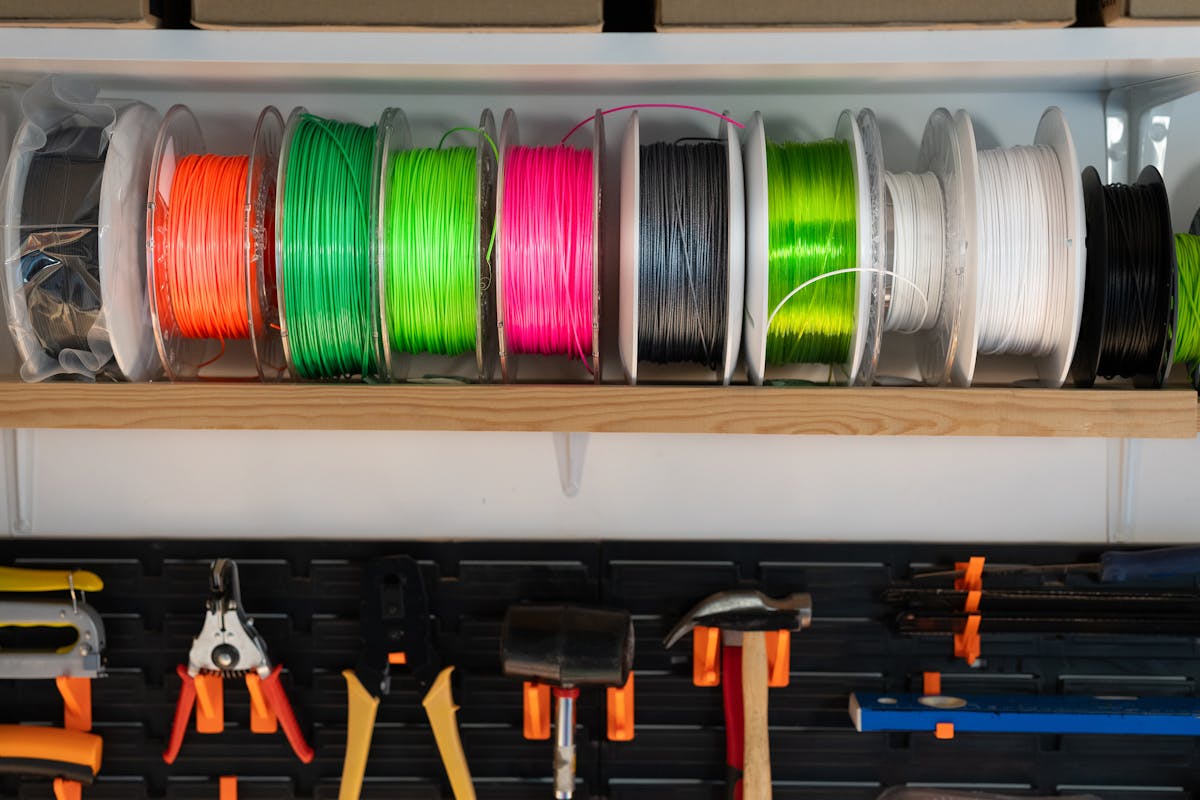
Basic Materials
Proven materials for most projects. Affordable, easy to print, dimensionally accurate, suitable for prototypes and final parts without extreme requirements.
PLA
The most widely used material for 3D printing. Easy to print, wide color selection, dimensionally accurate. Excellent for prototypes, visual models, and parts without mechanical stress. Not suitable for parts exposed to temperatures above 55 °C.
PETG
Versatile material with an excellent price-to-performance ratio. Chemically resistant, tough, handles impacts well. Suitable for covers, jigs, brackets, and parts in contact with water.
ABS
Classic industrial material. Heat resistant, rigid, easy to post-process (sanding, gluing, acetone smoothing). Suitable for automotive industry parts and mechanical assemblies exposed to temperatures up to 100 °C.
Engineering Materials
For parts that must withstand mechanical load, high temperatures, or outdoor conditions. Require more advanced printing conditions.
ASA
Alternative to ABS with significantly better UV resistance. The material of choice for outdoor applications - camera housings, sensor mounts, garden elements. Color and mechanical properties remain unchanged even after years in direct sunlight.
PA6 (Nylon)
High strength, toughness, and wear resistance. Suitable for gears, sliding bearings, pantographs, and parts subjected to repeated mechanical load. Absorbs moisture - store in a dry place.
PA12 (Nylon)
Lower moisture absorption than PA6, better dimensional stability. Handles chemicals and repeated stress well. Ideal for precision functional parts, connectors, and housings.
Polykarbonát (PC)
Extremely tough and impact resistant. Transparent, heat resistant up to 130 °C. We print at 350 °C on Prusa H2S/H2C. Used for protective covers, optical elements, and parts subjected to impacts.
Reinforced Materials (CF/GF)
Materials with carbon or glass fiber additives. Significantly higher stiffness and dimensional stability at low weight. We print on Prusa H2S, H2C, and Pro HT90.
PA-CF (Nylon + uhlíkové vlákno)
Nylon reinforced with short carbon fibers. Extreme stiffness at low weight. Dimensionally stable, minimal shrinkage. Replacement for metal parts in jigs, robotics, and drones.
PETG-CF (PETG + uhlíkové vlákno)
PETG reinforced with carbon fiber. Easier to print than PA-CF, no moisture absorption. A good choice for rigid covers, frames, and structural elements where you don't need extreme heat resistance.
PA-GF (Nylon + skelné vlákno)
Nylon reinforced with glass fibers. A more affordable alternative to PA-CF with good stiffness and heat resistance. Suitable for larger structural parts and industrial jigs.
High-Performance Materials
Top-tier polymers for the most demanding industrial applications. We print on Prusa Pro HT90 with nozzle up to 500 °C and heated chamber 90 °C.
PEEK
The top-tier thermoplastic for the most demanding applications. Heat resistance up to 250 °C, chemical resistance to almost anything, biocompatible. We print on Prusa Pro HT90 (nozzle 500 °C, chamber 90 °C). Replacement for metal parts in aerospace and medicine.
PEI / Ultem
High-temperature material used in the aerospace and space industry. Self-extinguishing (UL94 V-0), resistant to sterilization. Suitable for parts near engines, electronics, and repeatedly sterilizable instruments.
PPS (Polyfenylensulfid)
Chemically inert even to aggressive solvents and fuels. Dimensionally stable, minimal moisture absorption. Used in the chemical industry, automotive sector, and wherever standard plastics fail.
Flexible Materials
Elastic TPU-based materials for parts that must bend, absorb impacts, or seal. Various hardness levels to suit your needs.
TPU (85A)
Soft, elastic material similar to rubber. Ideal for seals, protective cases for electronics, damping pads, and ergonomic grips. Resistant to abrasion and repeated bending.
TPU (95A)
Harder variant of TPU for parts that need both flexibility and load-bearing capacity. Suitable for functional springs, hoses, roller covers, and parts subjected to repeated mechanical stress.
Resin
Photopolymer materials for maximum detail and smooth surface. Ideal for visual models, jewelry, and precision castings.
Standardní pryskyřice
Smooth surface with extreme detail (±0.05 mm). For visual prototypes, miniatures, figurines, and presentation models where appearance matters more than mechanical properties.
Technická pryskyřice
Combination of high detail and mechanical durability. Suitable for functional prototypes, precision brackets, and parts where you need resin's dimensional accuracy along with strength for real-world use.
Vypalitelná pryskyřice
For precision castings using the lost-wax method. Burns out completely during mold firing. Used for custom jewelry production, dental crowns, and precision metal castings.
Not Sure Which Material to Choose?
Describe what your part needs to withstand, and we'll recommend the most suitable material. We'll take into account mechanical requirements, operating temperature, environment, and budget.
Get Material AdviceSend us your model and get a quote within 24 hours
Just send an email with your STL/STEP file. We'll recommend a material, calculate the price, and give you a timeline.
Contact Us